Cast Iron Bed Frames: What to Know Before You Buy
By the American Iron Beds team
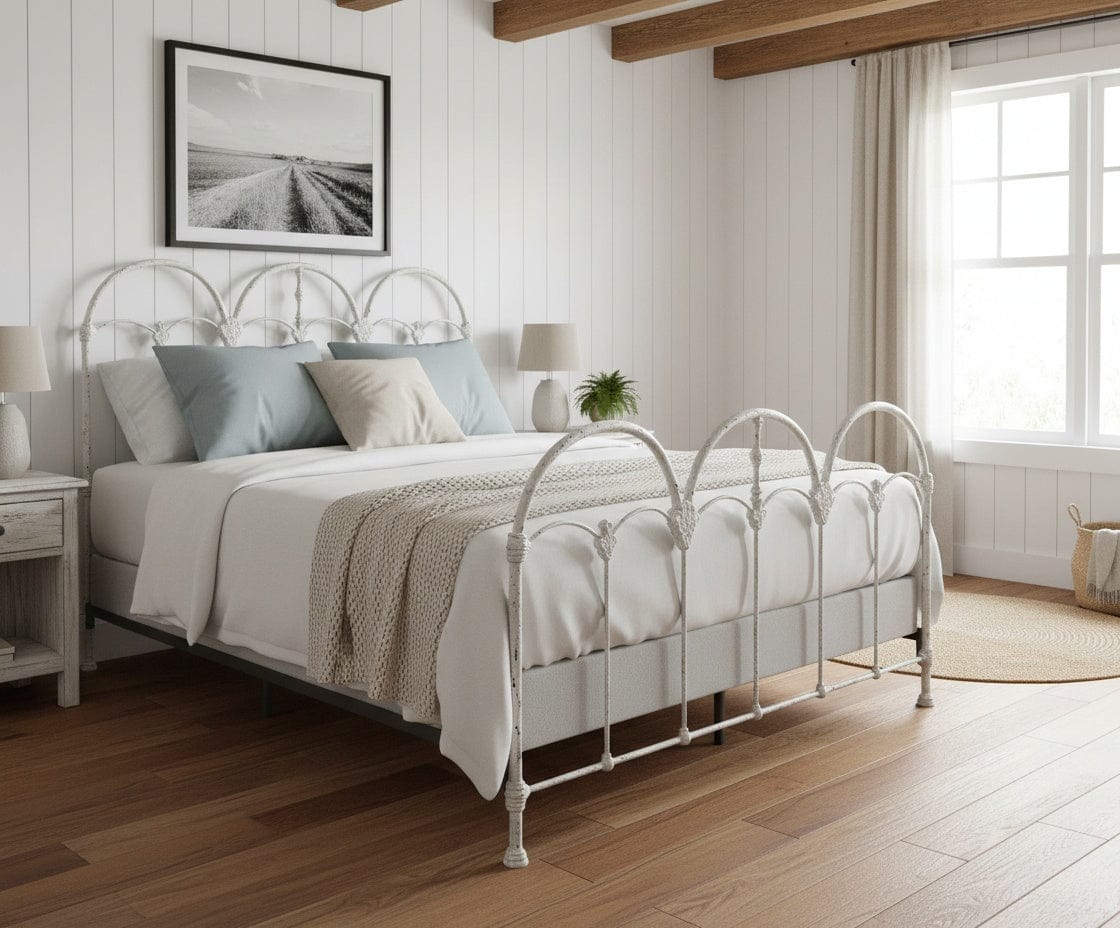
A cast iron bed frame today almost always means an iron bed with cast detail, not a frame poured entirely from cast iron. Fully cast frames are mostly antiques. A well-made modern version uses thick-walled steel tubing and solid iron rod for the structure, with molten metal poured around the weld joints to reinforce them and form the decorative castings.
So the right buying question is not "is it cast iron?" but "where is the cast detail, how was it made, and what is holding the bed up?" Cast iron captures fine ornament but is brittle, which is why modern beds put castings at the joints of a steel frame instead of casting the whole bed; the full materials story is in wrought iron vs cast iron beds. This guide is about choosing one.
What you are buying in a cast-detail bed
Every bed we offer is handcrafted to order in Los Angeles by our partner workshops. The structure is thick-walled steel tubing, the spindles and bars are solid iron rod, the headboard and footboard are each welded as one piece, and the castings are poured around the weld joints and filed by hand. The finish is applied by hand, so color and patina vary slightly from bed to bed, and that variation shows most on cast detail.

Two practical consequences for a shopper:
- Weight. A complete bed weighs roughly 100 to 250 pounds depending on the design. Plan delivery and placement around that.
- Under-mattress support. Center support legs and slats depend on the model, and slats are needed only for "mattress only" configurations. Check the product page for that bed's setup.
New cast-detail bed or a true antique?
Fully cast antique frames are a different purchase. The usual problems are sizes that predate modern mattresses, hairline cracks in brittle castings hidden under old paint, pre-1978 paint that may contain lead, missing side rails, and no warranty. Our guide to antique iron beds vs reproductions explains how to inspect one and when it is worth the work.
How to choose a cast iron bed frame
1. Decide where you want the cast detail
This is the decision that matters most, and it is really a question of where your eye lands in the room:
- Everywhere. Our Dream Gallery collection holds our most ornate designs, including every canopy bed. Look at the Chartres, Olwyn's Amulet and Morella.
- Concentrated at the head. A Headboard & Frame configuration keeps the cast headboard and drops the footboard, which suits smaller rooms. The Morella Low Foot keeps a footboard but lowers it.
- At the joints only. For classic designs with more restraint, browse the American Classics collection, including the Castine pictured at the top of this page and the Kennebunk.
Whichever level you choose, look at the close-up photos on the product page. The castings are where the hand-filing shows, and they tell you more about a design than the full-bed shot does.

About 80 percent of our customers buy a complete bed and about 15 percent choose headboard and frame. If you are weighing the two, our headboard only vs full iron bed guide walks through the tradeoffs.
2. Confirm the size and the outside dimensions
All of our beds are made for standard US mattress sizes, twin through California king. Queen and king are offered on nearly every design; twin is offered on fewer. Posts, finials and castings can add a few inches beyond the mattress, so check each bed's exact outside dimensions on its product page before you measure the room. Extra-long twin and extra-long full are available as a special order on many beds; call us to order. Shop by size: queen or king.

3. Choose a finish that shows off the castings
Bronze tones are our customers' most popular choice, followed by black, then white. On a cast-detail bed, the finish decides how much the castings stand out: a dark finish against a light wall outlines every collar and scroll, while a white or distressed finish softens them.

Finish lists differ by collection:
- American Classics and Dream Gallery use their own finish guide, with standard finishes such as Antique Bronze, Antique Black, White Matte and Distressed White, plus premium finishes for an added fee. You can order up to 4 finish samples after placing your order; they arrive in about a week, and you choose within about 2 weeks of receiving them.
- Iron Art and North Haven Traditions use a separate finish guide, including Aged Bronze, Aged Iron, Matte Black and Matte White. Samples are not offered for these collections.
For a full walk through the palettes, see custom iron bed finishes.
4. Check timing and delivery
American Classics and Dream Gallery beds are made to order in 6 to 8 weeks, Iron Art and North Haven Traditions in 10 to 14 weeks, plus 1 to 2 weeks of shipping; Quickship beds are in stock and ship in about a week. Free delivery goes to the first threshold, and for a heavy cast-detail bed you can add White Glove Delivery & Assembly for an added fee (see our shipping policy). Because every bed is made to order, there are no change-of-mind returns; our refund policy has the details.
For everything else that goes into choosing an iron bed, from construction to configurations, start with our complete iron bed buyer's guide. If you are unsure about size, finish or configuration, call us at (800) 378-1742, Monday to Friday, 9am to 5pm ET. We have helped more than 12,000 customers since 1999, and we would rather answer questions up front.
Frequently Asked Questions
How heavy is a cast iron bed frame?
Can you still buy a new cast iron bed frame?
Is an antique cast iron bed safe to sleep on?
Can I see finish samples before my bed is made?
Do cast iron beds rust?
Ready to Find Your Perfect Iron Bed?
Browse our iron beds, each handcrafted to order in Los Angeles by our partner workshops.
ornate Dream Gallery iron bedsAmerican Iron Beds, since 1999
Every bed is handcrafted to order in Los Angeles by our partner workshops, with thick-walled steel tubing, solid iron rod and hand-poured castings, and backed by a lifetime warranty. Questions? Call (800) 378-1742, Mon to Fri, 9am to 5pm ET.
Continue Reading
 Iron Beds & Frames
Iron Beds: The Complete Buyer's Guide for 2026
What to know before buying an iron bed: how quality beds are built, sizes, configurations, collections, finishes, lead times, delivery and care, from American Iron Beds, selling handcrafted iron beds since 1999.
 Wrought Iron Beds
Wrought Iron vs Cast Iron Beds: What's the Difference?
Wrought iron is worked and bends; cast iron is poured and rigid. Here is how antique beds used both, how modern iron beds combine steel tubing with poured castings, and what to check before you buy.
 Iron Beds & Frames
Antique Iron Beds vs Modern Reproductions: What Is the Difference?
Genuine antique iron beds have real patina and history, but often need work: non-standard sizes, possible lead paint, missing rails and no warranty. Here is how they compare with new antique-style beds and how to choose.