How to Style a Metal Headboard: Finish, Bedding and Walls
By the American Iron Beds team

To style a metal headboard, choose the finish first, then build the bedding, wall color, nightstands and lighting around it. Contrast, such as a dark headboard on a light wall, makes the ironwork the focal point; tone-on-tone makes it read as texture. Lean Euro shams against the bars so your pillows are not resting on bare iron, and keep the wall above the headboard simple.
American Iron Beds has sold iron beds and headboards since 1999, to more than 12,000 customers. This guide is about styling only: matching the design to the room, then finish, bedding, walls, nightstands, lighting and the foot of the bed, plus the mistakes we see most often. If you are still choosing a headboard, sizes or a configuration, start with our metal headboards buyer's guide.
Match the Design to the Room
The headboard's line sets how much styling the rest of the room can take.
Ornate statement headboards such as the Chartres from Dream Gallery carry the room on their own. Pair them with plain bedding, a quiet wall and simple nightstands, and let the castings do the work.

Cottage and farmhouse designs such as the Castine and the Belle from American Classics sit comfortably with linen, quilts, shiplap and painted wood, and are the easiest to layer with pattern.
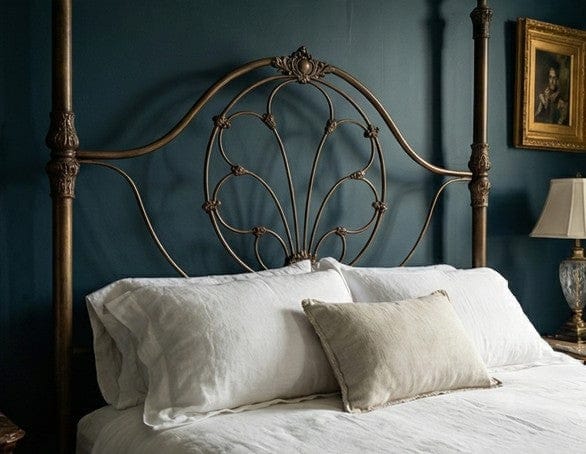
Simpler, clean-lined designs such as the Aspen read modern in black, white or a dark iron tone, and they handle bold bedding and large art better than an ornate headboard does. The Revere from North Haven Traditions, shown at the top of this post in Aged Iron, and the Sheffield are other designs worth comparing.

Start With the Finish
The finish sets the mood more than any other choice. Our finishes come in two palettes: the American Classics and Dream Gallery finishes and the Iron Art and North Haven Traditions finishes. Bronze tones are the most popular with our customers, followed by black, then white.
| Finish family | American Classics & Dream Gallery | Iron Art & North Haven Traditions | Styling effect |
|---|---|---|---|
| Dark and antiqued | Antique Black, Antique Bronze | Aged Iron, Aged Bronze, Matte Black | Visual weight; the headboard becomes the focal point, especially on a light wall |
| Light and white | White Matte, Distressed White | Matte White, Rustic Ivory | The headboard recedes and reads as form and texture |
| Bold color | Premium Farmhouse Red, Distressed Turquoise, Antique Blue, Antique Sage | Not offered in bold color; try Aged Rust | The headboard carries the room's color; keep walls and bedding quieter |
| Warm metallic | Premium Antique Gold, Smokey Gold, Black Gold | Brass Bisque, Aged Gold, Old Copper | Warmth without strong color; pairs with brass and copper fixtures |
Premium finishes carry an added fee. On American Classics and Dream Gallery orders you can request up to 4 finish samples after ordering, which is the best way to test a finish against your actual wall color and light. Our iron bed finishes guide covers every finish.

Bedding That Works With Metal Headboards
- Layered neutrals. White or cream sheets, a textured duvet in oatmeal, flax or warm gray, and a throw at the foot. It works with every finish and lets the headboard do the talking.
- All white against a textured finish. White bedding against Distressed White or Aged Iron makes a calm, tonal room where the interest comes from texture, not color.
- Jewel tones against bronze. Emerald, sapphire, burgundy or mustard against Antique Bronze or Aged Bronze reads rich and collected, a natural fit for traditional rooms.
- Pattern with a simple headboard. Bold florals, stripes or geometrics work well against a headboard with clean lines. With an ornate headboard, keep the bedding simpler.
- Linen. Its relaxed texture suits hand-applied finishes, which vary naturally from piece to piece.
Pillow arrangement. Lean two large Euro shams (26 x 26 inches) against the headboard, then two sleeping pillows, then one or two accent pillows. The Euros create a soft backdrop so you are not leaning on bare iron when you sit up in bed.
Wall Color and Wall Treatments
- Contrast for drama. Antique Black against warm white, or Distressed White against deep navy. Every curve and casting shows.
- Tone-on-tone for calm. Aged Iron against charcoal, or Matte White against soft white. The headboard becomes texture, and small rooms feel larger.
- Accent walls show through. An open iron headboard lets an accent wall stay visible, which a solid upholstered headboard would cover.
- Wall treatments. Shiplap, board and batten, brick, plaster and wallpaper all show between the bars. Distressed White on shiplap is a classic farmhouse pairing; Aged Iron on brick suits an industrial room.
Judge the pairing in the light you will actually see it in. Look at the finish photos on the product page, or a finish sample on American Classics and Dream Gallery orders, next to your wall in the evening under your own lamps.

Nightstands
- Match the metal temperature, not the material. Warm finishes (bronzes, golds, coppers) pair with warm wood and brass hardware; cool finishes (blacks, steels, whites) with cooler tones.
- Mismatched is fine. Iron does not create a wood-matching problem, so two different nightstands can look deliberate.
- Mind the scale. Nightstand tops at roughly mattress height look right. An ornate headboard needs nightstands with some substance; a simple one suits leaner pieces.
- Keep the tops clear. A lamp, a small plant and room for a phone and water glass. Let the ironwork provide the detail.
Lighting
- Use warm bulbs. Warm white bulbs (around 2700K to 3000K) bring out depth in bronze, gold and antiqued finishes. Cool daylight bulbs can make them look flat.
- Sconces go on the wall, not the headboard. Wall sconces flanking the bed free up nightstand space. Mount them on the wall; the ironwork is not designed to hold fixtures.
- Add height overhead. A pendant or chandelier adds the vertical interest a headboard alone does not. With a canopy bed, the canopy frame already does that job.
Styling the Foot of the Bed
With a Headboard Only or Headboard & Frame setup, the foot of the bed is open, and it can look unfinished. A bench, a throw folded across the end of the mattress, or a rug that extends well past the foot gives the bed an edge. With a complete bed, keep the foot simple so the footboard ironwork stays visible. Our headboard only vs full iron bed guide covers which configuration to choose.

Four Styling Mistakes to Avoid
- Art hung too close. If you hang art or a mirror above the headboard, leave roughly 6 to 8 inches of wall between them. Often the headboard is enough on its own.
- Clashing metals. A warm bronze headboard surrounded by chrome feels unresolved. Keep metals in the same temperature family, or mix them deliberately with several pieces, not one.
- A crowded headboard wall. Sconces plus art plus shelves plus a gallery wall is too much. The ironwork already provides detail.
- Ornate on ornate. An intricate headboard with busy patterned bedding competes. Go bold on one, simple on the other.
To talk through finishes for your room, call us at (800) 378-1742, Monday to Friday, 9am to 5pm ET. For more looks, see our modern wrought iron bed ideas.
Frequently Asked Questions
How do I style a bed without a footboard?
What should I hang above a metal headboard?
Can a metal headboard look modern?
How do I make a metal headboard feel cozy?
What wall color is best behind a metal headboard?
Ready to Find Your Perfect Iron Bed?
Browse our iron beds, each handcrafted to order in Los Angeles by our partner workshops.
North Haven Traditions headboardsAmerican Iron Beds, since 1999
Every bed is handcrafted to order in Los Angeles by our partner workshops, with thick-walled steel tubing, solid iron rod and hand-poured castings, and backed by a lifetime warranty. Questions? Call (800) 378-1742, Mon to Fri, 9am to 5pm ET.
Continue Reading
 Metal Headboards
Metal Headboards: The Complete Buyer's Guide for 2026
How to choose a metal headboard: styles, sizing, configurations, how headboards attach, quality checks, finishes, and an honest comparison with upholstered headboards.
Metal HeadboardsMetal Headboard vs Bed Frame: Headboard Only or Full Bed?
Headboard only, headboard & frame, or a complete iron bed? An honest comparison of stability, appearance and relative cost, plus which designs limit your choice.
 Wrought Iron Beds
Iron Bed Styles: Modern, Rustic, French Country & More
A style-by-style guide to iron beds: what defines modern, transitional, traditional, rustic and French country designs, which configurations and finishes suit each, and the beds to start with.