What Size Iron Bed Fits a Small Bedroom? A Room Layout Guide
By American Iron Beds · Handcrafting Iron Beds in Los Angeles Since 1999
By the team at American Iron Beds · Handcrafting iron beds in Los Angeles since 1999
Choosing an iron bed for a small bedroom isn't just about picking a mattress size. It's about understanding how the bed's footprint, the iron frame's visual presence, and the room's dimensions all work together. Get it right and a small bedroom feels intentional and elegant. Get it wrong and you're squeezing past the bed to reach the closet.
Our manufacturing partners have handcrafted iron beds in Los Angeles since 1999, and small-bedroom sizing is one of the most common conversations we have with customers. This guide covers exactly how much room each iron bed size needs, which configurations save the most space, and why iron beds are actually better suited to small bedrooms than most people expect.
Why Iron Beds Work in Small Bedrooms
Before we get into dimensions, it's worth understanding why an iron bed is often a better choice for a small room than a wood or upholstered alternative.
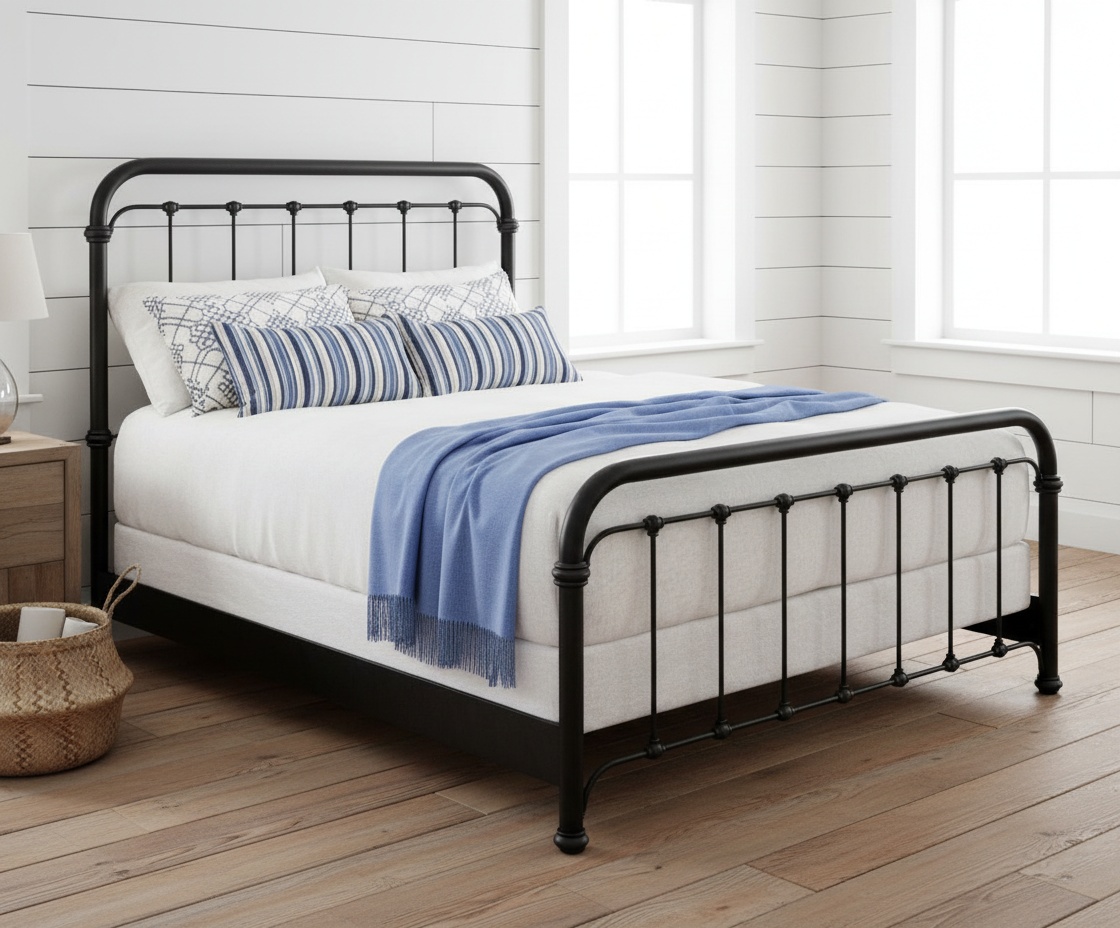
Visual transparency. This is the single biggest advantage. Iron beds have an open, see-through quality that lets the eye travel through and around the frame. A solid wood panel bed or a bulky upholstered frame creates a visual wall that stops the eye and makes the room feel smaller. An iron headboard and footboard frame the bed without closing it in. In a small bedroom, that difference in perceived space is dramatic.
After more than 25 years of hearing customer feedback, we can say this with confidence: the most common reaction when someone puts an iron bed in a small room for the first time is surprise at how much more open the room feels compared to their old bed. The actual footprint may be similar, but the visual footprint is much smaller.
Lighter finishes amplify the effect. An iron bed in Matte White (soft, chalky, warm), Distressed White (white with dark base showing through), or Rustic Ivory (warm cream with mottled texture) virtually disappears against a light wall, making the room feel even more spacious. Darker finishes like Matte Black or Aged Iron still maintain the visual transparency advantage over solid furniture, though the contrast with light walls makes them more visually prominent.
Headboard-only saves real space. Eliminating the footboard removes several inches of furniture from the foot of the bed and opens the sightline across the room. In a bedroom where every inch matters, the headboard-only configuration is a meaningful space saver. More on this below.
Room Dimensions by Bed Size
Here are the minimum room dimensions that allow comfortable movement around each iron bed size, plus our recommended dimensions for a room that feels spacious rather than just functional.
Twin Iron Bed (39" W x 75" L)
Mattress footprint: 3'3" x 6'3"
Minimum room size: 7' x 10' (70 sq ft). This gives you about 24 inches of clearance on one side of the bed and at the foot, which is enough to walk through but tight.
Recommended room size: 8' x 10' (80 sq ft) or larger. This allows clearance on both sides of the bed for making it, plus room for a nightstand and a small dresser.
Best for: Children's rooms, single guest rooms, narrow rooms, studio apartment sleeping nooks. A twin iron bed with a headboard-only configuration is also a simple, elegant alternative to a daybed in a multipurpose room.
Extra-long Twin (39" x 80") adds 5 inches of length. Available for $75 additional. Consider this for teens or taller guests.
Full Iron Bed (54" W x 75" L)
Mattress footprint: 4'6" x 6'3"
Minimum room size: 9' x 10' (90 sq ft). This gives about 24 inches of clearance on each side.
Recommended room size: 10' x 10' (100 sq ft) or larger. A 10x10 room with a full-size iron bed leaves space for two nightstands and a dresser along the opposite wall without feeling crowded.
Best for: Guest bedrooms, smaller master bedrooms for single sleepers who want more room than a twin, and apartments where a queen feels too large. The full-size iron bed hits a sweet spot: enough sleeping surface to be comfortable without dominating a moderate room.
Extra-long Full (54" x 80") adds 5 inches of length. Available for $75 additional.
Why full-size iron beds have a special visual proportion: At 54 inches wide, a full-size bed doesn't overwhelm a room the way a queen can in tight spaces. The iron frame's visual transparency makes it feel even more proportional. If you're furnishing a classic guest bedroom or cottage-style room, a full iron bed in Distressed White or Farmhouse Beige often looks more intentional and better-scaled than a queen squeezed into the same space.
Queen Iron Bed (60" W x 80" L)
Mattress footprint: 5' x 6'8"
Minimum room size: 10' x 10' (100 sq ft). At this minimum, a queen iron bed fits with basic clearance but leaves very little room for furniture beyond small nightstands.
Recommended room size: 10' x 12' (120 sq ft) or larger. At this size, you get comfortable 24-30 inch walkways on both sides, room for nightstands, and space for a dresser without the room feeling packed.
Best for: Master bedrooms and larger guest rooms. Queen is our most popular size by a significant margin, for the full breakdown on queen dimensions, mattress compatibility, and configurations, see our queen iron bed buying guide. In rooms 10x12 or larger, a queen iron bed is almost always the right call. In rooms smaller than 10x10, seriously consider whether a full might be the better choice. A comfortable room with a full bed beats a cramped room with a queen.
The queen iron bed in small rooms, the real talk: We see customers force queen beds into rooms that would be better served by a full, and then they're unhappy with how tight the room feels. If your room is under 100 square feet and you're debating between full and queen, go full. The 6 extra inches of mattress width aren't worth the trade-off in living space. If you're over 100 square feet, the queen works.
King Iron Beds: When They Fit and When They Don't
We build iron beds in both Eastern King (76" W x 80" L) and California King (72" W x 84" L). These are not small-bedroom beds. If you're reading this guide because your bedroom is tight on space, a king is almost certainly too large.
Minimum room for Eastern King: 12' x 12' (144 sq ft). Anything smaller and you're sacrificing walkways or furniture.
Minimum room for California King: 12' x 12' (144 sq ft). The California King is 4 inches narrower but 4 inches longer than Eastern King, so it works slightly better in long, narrow rooms.
If you're working with a room under 144 square feet and want a king, we'd encourage you to call us at (800) 378-1742 to talk through the layout before ordering. We'd rather help you find the right fit than process a return.
Space-Saving Configurations
The configuration you choose can gain or lose several inches of usable room space. In a small bedroom, that matters.
Headboard Only
What it includes: The headboard and mounting hardware. Pre-drilled with 15 holes to attach to most standard bed frames.
Space saved: Eliminating the footboard removes the visual barrier at the foot of the bed and opens the sightline across the room. The actual footprint savings depend on the footboard design, ornate footboards can extend 3-5 inches beyond the mattress edge, but the visual savings are much larger than the physical ones.
Trade-off: If you attach our headboard to a standard retail frame, there may be some wobble. Retail frames aren't built to match our headboards as precisely as the frames we make alongside them. For a guest room, kids' room, or rental property, this is perfectly fine. For a primary bedroom, consider the headboard + frame option. For a detailed breakdown of all three configurations, including cost, stability, and appearance, see our headboard vs complete bed comparison.
Headboard + Frame (No Footboard)
What it includes: Headboard plus our matched frame in matte black or gunmetal grey (depending on collection).
Space saved: Same visual openness as headboard-only at the foot of the bed, but with a matched frame that eliminates wobble.
Best for small bedrooms: This is the configuration we recommend most for small rooms. You get the iron bed quality, the stability of a matched frame, and the openness of no footboard. It's the best of both worlds when space is limited.
Complete Bed (Headboard + Footboard + Frame)
What it includes: Headboard, footboard, and full frame system.
Space impact: The footboard adds visual weight at the foot of the bed. In a large room, this completes the classic iron bed look beautifully. In a room under 100 square feet, the footboard can make the bed feel like it owns the room rather than sharing it.
When it still works in a small room: If the room is at or above the recommended minimum for your bed size and you're drawn to the complete bed look, go for it. The iron frame's transparency still gives you more openness than a solid wood or upholstered bed with a footboard would. Just be realistic about the room dimensions.
Platform Height vs Standard Height
12-inch platform height (mattress only, no box spring) keeps the overall bed profile lower. In a small room with standard 8-foot ceilings, a lower bed profile makes the room feel taller and more open. This is a subtle effect but a real one.
8-inch or 9-inch standard height (designed for box spring and mattress) sits the sleeping surface higher. This creates more clearance under the bed, which is valuable storage space in a small bedroom. Under-bed storage bins, off-season clothing, or luggage can all fit beneath a standard-height iron bed.
Choose platform if you want the room to feel more spacious. Choose standard height if you need the storage.
Layout Tips for Small Bedrooms with Iron Beds
Center the headboard on the longest wall. This is the most common layout and it works for a reason. It maximizes walkway space on both sides of the bed and creates a balanced look. In very small rooms (under 90 sq ft with a full or twin), pushing the bed against one wall and accepting a single walkway is a legitimate space-saving move.
Position the bed so you see through it from the doorway. This is where the iron bed's visual transparency pays off the most. When you enter the room and can see through the headboard or footboard to the wall or window behind it, the room reads as larger. A solid bed blocks that sightline entirely.
Use the headboard as your wall statement. In a small bedroom, you don't have room for a headboard and art above it and sconces flanking it. The iron headboard is the statement. Let it work on its own against the wall without competing with other wall decor at the same height.
Match the finish to the wall color for maximum spaciousness. Matte White against a white wall, Aged Iron against a dark grey wall, or Farmhouse Beige against a warm neutral wall. When the bed finish blends with the wall, the frame visually recedes and the room opens up. Contrast (dark bed, light wall) makes the bed more prominent as a design piece, which is great in rooms where you have space to spare but less ideal when you're trying to make a small room feel bigger.
Don't skip a nightstand. Even in a tight room, a narrow nightstand (12-14 inches deep) on at least one side keeps the bedroom functional. A room that looks spacious but has nowhere to put your phone and water glass feels like a compromise. If you can only fit one nightstand, put it on your dominant side.
Frequently Asked Questions
What's the smallest room that can fit an iron bed?
A twin iron bed with headboard-only configuration can fit in a room as small as 7' x 9' (63 sq ft), though 7' x 10' is more comfortable. For a full, the practical minimum is 9' x 10'. For a queen, 10' x 10'. Below these sizes, the room will feel tight regardless of the bed style.
Is a full or queen better for a small master bedroom?
If your room is under 100 square feet, a full is almost always the better choice. The 6-inch difference in mattress width doesn't justify losing walkway space and furniture room. At 100+ square feet, a queen works well, especially with a headboard + frame (no footboard) configuration. If you're a couple sharing the bed, the queen's extra width becomes more important, in that case, we'd lean toward the queen if the room is at least 100 square feet.
Do iron beds take up more space than wood beds?
The mattress footprint is identical regardless of frame material. Iron beds actually feel like they take up less space because of the visual transparency, you can see through the frame, which makes the room feel more open. A solid wood panel bed with the same mattress has the same footprint but a much heavier visual presence.
Can I use a headboard-only iron headboard with a platform bed frame?
Yes. Our headboard-only option is pre-drilled with 15 holes and attaches to most standard bed frames, including platform frames. This combination (our headboard + a low-profile platform frame) gives you the iron bed aesthetic with the lowest possible bed profile, which is ideal for small rooms.
Should I choose a light or dark finish for a small bedroom?
Light finishes (Matte White, Distressed White, Rustic Ivory, White Matte) make the bed visually recede, maximizing the sense of space. Dark finishes (Matte Black, Aged Iron) create more visual contrast and make the bed a focal point. Both work in small rooms because of the iron frame's transparency, but if maximizing perceived space is the priority, go light. For more on choosing finishes, see our iron bed finishes guide.
Find the Right Size for Your Room
Not sure which size works for your bedroom? Call us at (800) 378-1742 and tell us your room dimensions. We'll walk you through the options and help you find the best fit. We'd rather spend ten minutes on the phone getting the size right than process a return because the bed overwhelmed the room.
Browse our Iron Art collection or American Classics to see the full range of designs, and check our iron beds buyer's guide for the complete sizing breakdown across all bed sizes. For headboard-specific guidance, see our metal headboards buyer's guide.
About American Iron Beds: We are a Los Angeles-based company specializing in handcrafted iron beds built using construction methods proven since the late 19th century. Every bed is made to order, finished by hand, and backed by a lifetime structural warranty. 27+ years in the iron bed business. Call us at (800) 378-1742.
Frequently Asked Questions
Ready to Find Your Perfect Iron Bed?
Browse our collection of handcrafted iron beds, each built to last a lifetime in Los Angeles by our manufacturing partners.
Iron Art collectionAmerican Iron Beds
Handcrafting Iron Beds in Los Angeles Since 1999
Founded in 1999, our iron beds are handcrafted in Los Angeles by our manufacturing partners using construction methods proven since the late 1800s, thick-walled steel tubing, solid iron rod, and hand-poured metal castings. Every bed comes with a lifetime structural warranty.
Continue Reading
Iron Beds & FramesIron Beds: The Complete Buyer's Guide for 2026
Everything you need to know before buying an iron bed frame: types, styles, sizes, construction quality, and care. A comprehensive buyer's guide from a manufacturer with 27+ years of experience.
 Metal Headboards
Metal Headboards: The Ultimate Buyer's Guide for 2026
Everything you need to know about metal headboards: styles, sizing by bed size, mounting options, finish choices, and headboard-only vs complete iron bed frames.
 Wrought Iron Beds
Modern Wrought Iron Bed Ideas: Industrial Loft to Coastal Farmhouse
Wrought iron bed design ideas for every style: industrial, Victorian, farmhouse, coastal, bohemian, and modern. See finish pairings and room styling tips.