Iron Beds: The Complete Buyer's Guide for 2026
By the American Iron Beds team
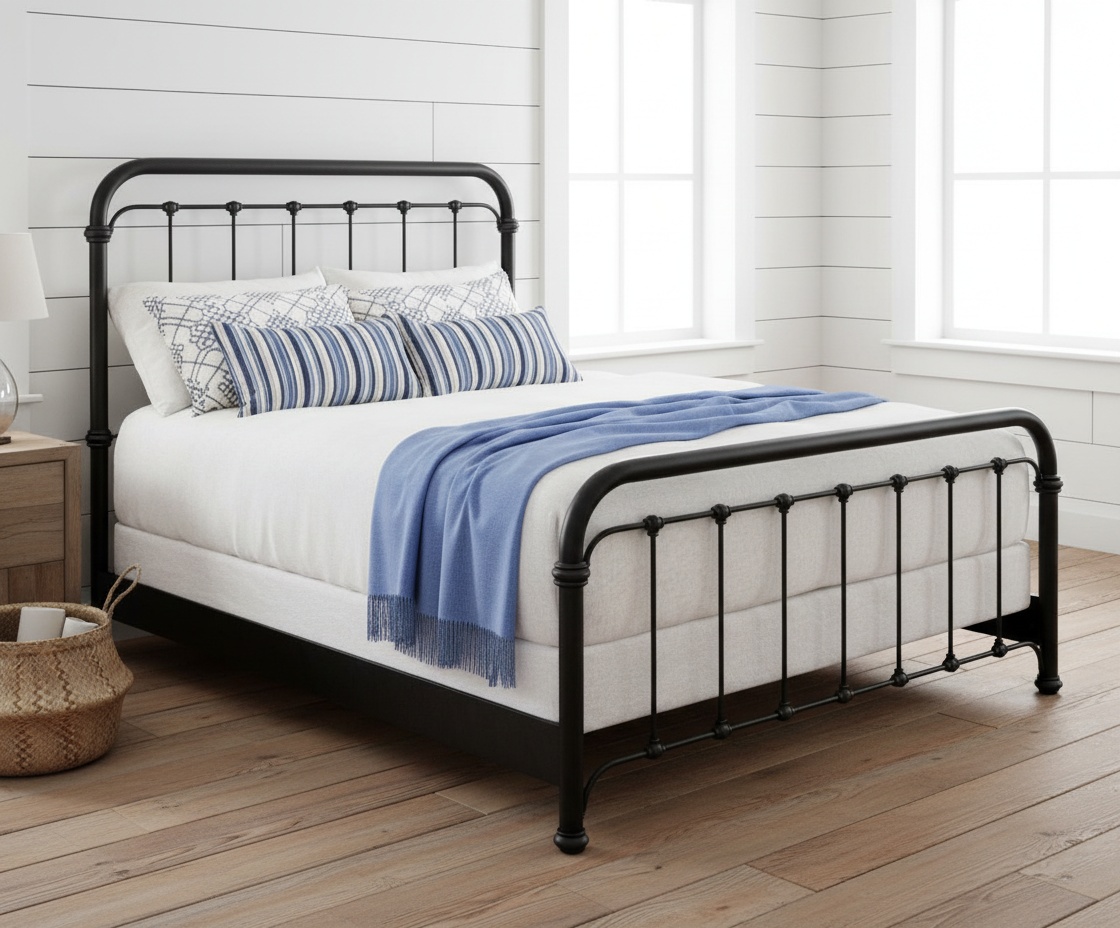
What's In This Guide
An iron bed is a bed whose headboard, footboard and side rails are made of metal. On a well-made one, that means steel tubing and solid iron rod welded into one-piece headboards and footboards, reinforced with cast joints and finished by hand. Good iron beds are made to order for standard US mattress sizes and sold in a few configurations, from a headboard only to a complete bed. To choose one, settle five things in order: size, configuration, collection (which sets the finish palette and lead time), finish, and delivery.
We have sold iron beds since 1999 to more than 12,000 customers. Every bed in our collections is handcrafted to order in Los Angeles by our partner workshops, and our beds have appeared in Seinfeld, Country Living and The Knick. This guide covers what we walk buyers through before they order: how the beds are built, how to pick a size and configuration, what each collection offers, finishes, timing, delivery and care.
Iron Beds at a Glance
| Question | Short answer |
|---|---|
| What are they made of? | Thick-walled steel tubing for the frame, solid iron rod for spindles and decorative bars, hand-poured castings at the weld joints |
| What sizes? | Twin, full, queen, king and California king. Extra-long twin and full by special order on many designs |
| Which configurations? | Complete bed (box spring or mattress only), headboard & frame, or headboard only |
| How long does it take? | 6 to 8 weeks to make (American Classics, Dream Gallery) or 10 to 14 weeks (Iron Art, North Haven Traditions), then 1 to 2 weeks to ship. Quickship beds ship in about a week |
| How heavy? | Roughly 100 to 250 lbs for a complete bed, depending on the design |
| Warranty? | Lifetime warranty under normal use |
How a Quality Iron Bed Is Built
Construction is where iron beds differ most, and most of it is invisible in a product photo. Here is how the beds we sell are made:
- Frame structure: thick-walled steel tubing.
- Spindles and decorative bars: solid iron rod, not tubing.
- One-piece headboards and footboards: each is welded as a single piece, so there are no bolted sub-sections inside the headboard or footboard to work loose.
- Hand-poured castings: molten metal is poured around the weld joints. The casting reinforces the joint and forms the decorative detail at the same time, and each casting is then filed by hand.
- Hand-applied finish: finishes are applied by hand, so color and patina vary naturally from piece to piece. No two beds look exactly alike.
- Bolt-on side rails: the rails bolt to the headboard and footboard with very simple tools. If you would rather not assemble it, White Glove delivery includes assembly.
The castings are the detail to look at closely. Because the metal is poured around the joint rather than screwed or glued on afterward, the ornament and the joint reinforcement are the same piece of metal. Trim that is attached after welding adds looks but no strength.

When you compare iron beds from any seller, ask the same questions. Is the headboard one welded piece or several parts bolted together? Are the castings poured around the joints, or attached afterward as trim? Are the spindles solid rod? Is the finish applied by hand? What does the warranty cover, and for how long? For more depth, see the history and construction of iron beds, wrought iron vs cast iron beds and what separates a quality iron bed.
Iron vs Wood vs Upholstered Beds
Most buyers are weighing iron against one of the other two. Here is a plain comparison:
| Iron bed | Wood bed | Upholstered bed | |
|---|---|---|---|
| Main joints | Welded headboard and footboard, bolt-on rails | Wood joinery and hardware | Fabric and padding over a frame |
| Look | Open and see-through; reads lighter in a small room | Solid | Solid and soft |
| Cleaning | Dust; wipe with a damp cloth | Dust; wood care products | Vacuum and spot-clean fabric |
| Sitting up to read | Firm; prop pillows against it | Firm | Padded |
| Color range | Wide range of hand-applied finishes | Stains and paints | Fabric choices |
Iron's real tradeoff is sitting up in bed: metal is not a padded surface, so readers prop pillows against it. Its strengths are the welded structure, the open look and easy care. Our iron bed vs wood bed comparison goes further.
Choose a Configuration
Our designs come in up to four configurations: Headboard Only, Headboard & Frame (no footboard) and a Complete Bed. On Iron Art and North Haven Traditions designs the Complete Bed is listed in two versions, one that takes a box spring and one for a mattress only; each product page shows exactly which options that design offers. Here is what each includes and how our customers actually buy:
| Configuration | What you get | Who it suits |
|---|---|---|
| Complete Bed | Headboard, footboard and side rails, in a box-spring or a mattress-only version | The full iron bed look; about 80% of our customers choose a complete bed |
| Headboard & Frame | Headboard and side rails, no footboard | An open foot of the bed with matched rails; about 15% of our customers |
| Headboard Only | Headboard, attached to a frame you supply | Keeping a frame you already own, guest rooms |
A few details that trip people up:
- Box spring or mattress only. Slats are needed for mattress-only setups, not for box-spring setups. Center support legs and slats depend on the model, so check the product page.
- Rail color. American Classics and Dream Gallery beds come with standard gunmetal rails, or rails painted to match your finish for an added fee. Frame details vary by collection; the product page lists them.
- Canopy beds are complete beds only. They are not sold as a headboard only, and neither are the five Iron Art platform beds.
Our headboard only vs complete bed guide compares the three in detail, and the metal headboards guide covers headboard styles and sizing.
Choose a Size
All our beds are made for standard US mattress sizes:
| Size | Mattress (W x L) | Availability |
|---|---|---|
| Twin | 38" x 75" | Fewer designs, mostly in American Classics and Dream Gallery |
| Full | 54" x 75" | Most designs; a few start at queen |
| Queen | 60" x 80" | Nearly every design |
| King (standard or Eastern) | 76" x 80" | Nearly every design |
| California king | 72" x 84" | Nearly every design |
- Plan with the outside dimensions. Posts, castings and decorative pieces can add a few inches of length or width beyond the mattress. Every bed's exact outside dimensions are on its product page; use those to plan the room, not the mattress size.
- King and California king are not interchangeable. King is 4 inches wider; California king is 4 inches longer. Measure your mattress before ordering: 76 inches wide is a king, 72 inches wide is a California king.
- Extra-long sizes. Extra-long twin and extra-long full are a special order on many beds, and the cost varies by bed. Call (800) 378-1742 to order one.
- Custom height. On American Classics and Dream Gallery beds, headboard, footboard and side-rail heights can be raised by up to 13 inches for an added fee. Custom height is not available on Iron Art or North Haven Traditions.
For room planning by size, see our queen iron bed frame guide, king iron bed frame guide and small bedroom size guide.
Styles and Where to Find Them
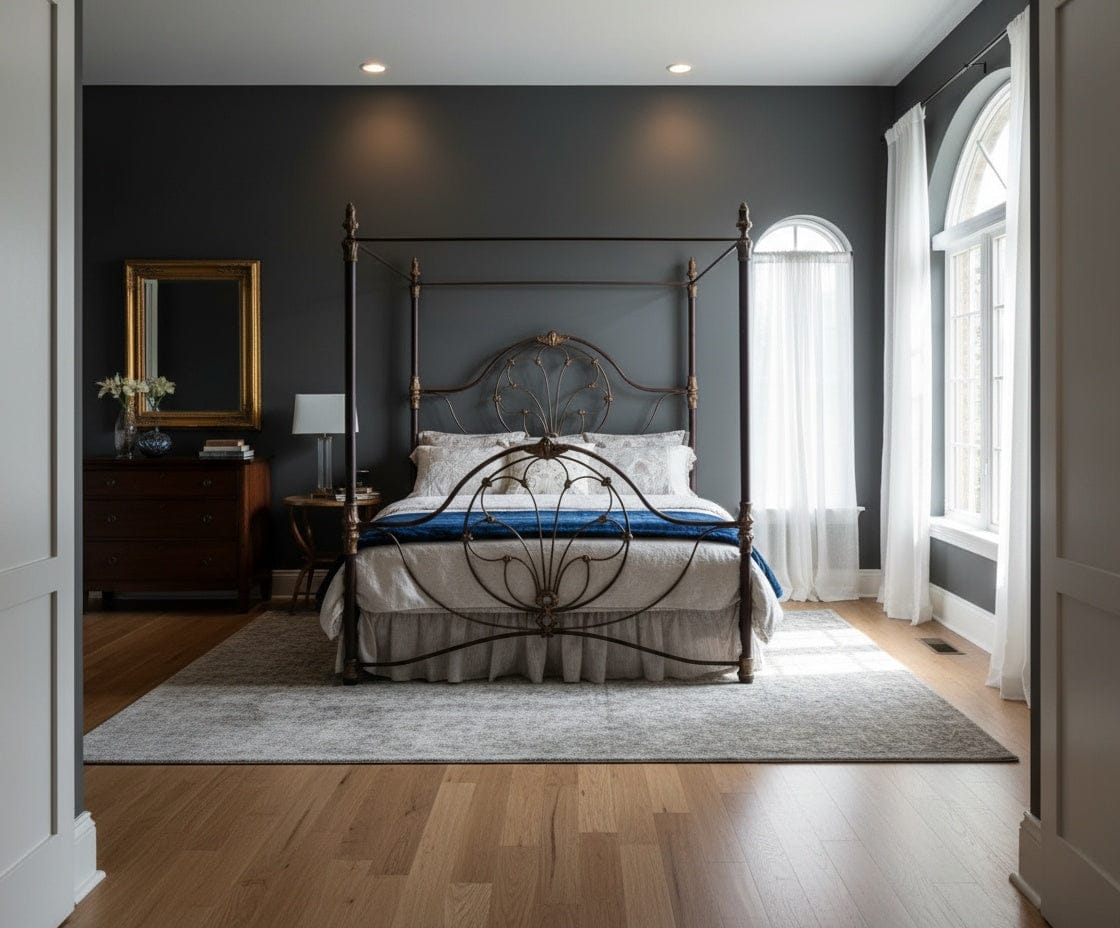
Canopy beds. Four tall posts joined by an overhead frame. We offer six, all in Dream Gallery, including the Morella Canopy. Compare the bed's overall height on its product page with your ceiling before ordering; our iron canopy beds guide covers the details.

Four-poster beds. Tall posts without the overhead frame, offered across collections, from the Brighton in American Classics to the Laurel and Merrick in Iron Art. Browse all four-poster beds.
Platform beds. Five Iron Art "surround" designs, such as the Sheffield Surround, sold as complete beds.

Daybeds. The Blake Daybed and Avery Daybed are twin size, with trundle options, for guest rooms and offices.
Farmhouse. Simpler American Classics designs such as the Castine and Kennebunk, which our customers often pair with white and bronze finishes. See our farmhouse iron beds guide.
Ornate, Victorian and modern. Dream Gallery holds our most ornate designs; see Victorian iron beds and wrought iron beds. For simpler silhouettes in black or white, see our modern wrought iron bed ideas.
Compare Our Four Collections
| Collection | Made to order in | Finish palette | Custom height | Finish samples |
|---|---|---|---|---|
| American Classics | 6 to 8 weeks | American Classics palette, standard and premium | Yes, up to +13" | Yes |
| Dream Gallery: most ornate, all canopy beds | 6 to 8 weeks | Same as American Classics | Yes, up to +13" | Yes |
| Iron Art: includes the platform beds | 10 to 14 weeks | Iron Art palette, all standard | No | No |
| North Haven Traditions | 10 to 14 weeks | Same as Iron Art | No | No |
Shipping adds 1 to 2 weeks after production, with rural areas at the upper end. A few designs, including the Braden, Sheffield and Quati, appear in both Iron Art and North Haven Traditions. If you need a bed sooner, our Quickship beds are in stock and ship in about a week, at the same price as made to order. Stock is limited and changes often. You can also browse every iron bed at once, or read our collections comparison.

Choose a Finish
Across all collections, our customers' most popular finishes are bronze tones first, then black, then white. Each pair of collections has its own palette:
- American Classics and Dream Gallery (finish guide): 13 finishes in all. Four are standard: Antique Bronze, Antique Black, White Matte and Distressed White. Nine premium designer finishes carry an added fee: Farmhouse Beige, Farmhouse Red, Farmhouse Gray, Distressed Turquoise, Antique Sage, Antique Blue, Antique Gold, Smokey Gold and Black Gold.
- Iron Art and North Haven Traditions (finish guide): bronzes such as Aged Bronze; black in Matte Black; whites such as Matte White and Rustic Ivory; plus metallic and rust tones such as Brass Bisque, Aged Gold, Aged Steel, Aged Iron, Aged Rust, Old Copper and Espresso. Every finish is standard, with no premium tier.
Because finishes are applied by hand, color and patina vary naturally from piece to piece. On American Classics and Dream Gallery beds, you can request up to 4 finish samples after you order. They arrive in about a week, depending on location, and you make your final choice within about 2 weeks of receiving them. Samples are not offered for Iron Art or North Haven Traditions. For more, see our iron bed finishes guide, black iron beds and white iron beds.

Timing, Delivery, Warranty and Returns
- Lead time: set by the collection (see the table above), plus 1 to 2 weeks of shipping. Quickship beds ship in about a week.
- Delivery: free in the contiguous US to the first threshold, meaning the first dry area such as a doorway, garage or porch. Alaska, Hawaii and remote addresses pay a surcharge; see our shipping policy. A complete bed weighs roughly 100 to 250 lbs, so plan on two people to carry the pieces in.
- White Glove Delivery & Assembly: optional, for an added fee. The crew carries the bed into the room you choose and assembles it. The path and the space must be clear when the bed arrives.
- Warranty: a lifetime warranty covering the bed under normal use. It does not cover damage from accidents or impacts, such as hitting the bed while moving it.
- Returns: every bed is made to order, so we do not accept change-of-mind returns or exchanges. Report damage or an incorrect item within 14 days of delivery and we repair or replace it at no cost. You can cancel within 72 hours of ordering for a full refund. After 72 hours, a 50% cancellation fee applies to standard collections, and custom orders and Dream Gallery beds are non-refundable once in production. Full terms are in our refund policy.
That return policy is the honest cost of a made-to-order bed, and it is why we suggest measuring carefully, confirming your mattress size and using finish samples where they are offered.
Caring for an Iron Bed
- Dust with a soft, dry cloth. For marks, use a slightly damp cloth with mild soap, then dry right away.
- Skip abrasive cleaners, steel wool and harsh chemicals, which can damage a hand-applied finish.
- Lift the bed when you move it rather than dragging it, and put felt pads under the legs on hard floors.
- Check the side-rail bolts now and then and snug them if needed.
Our iron bed care guide covers cleaning and finish care in more detail.
A Five-Step Buying Checklist
- Measure the room and ceiling, then compare them with the outside dimensions on the product page.
- Confirm your mattress size (king or California king?) and if you use a box spring.
- Pick a configuration: complete bed, headboard & frame, or headboard only.
- Pick a collection by design, finish palette and timeline, or check Quickship if you need the bed soon.
- Choose delivery: free threshold delivery or White Glove.
Questions about a specific bed? Call us at (800) 378-1742, Monday to Friday, 9am to 5pm ET. We hold 4.9 stars from more than 250 customer reviews and are a BBB Accredited Business.
Frequently Asked Questions
Do iron beds squeak?
How heavy is an iron bed?
How long does it take to get an iron bed?
Do I need a box spring with an iron bed?
Can I return an iron bed if I change my mind?
What does the lifetime warranty cover?
Ready to Find Your Perfect Iron Bed?
Browse our iron beds, each handcrafted to order in Los Angeles by our partner workshops.
all iron bedsAmerican Iron Beds, since 1999
Every bed is handcrafted to order in Los Angeles by our partner workshops, with thick-walled steel tubing, solid iron rod and hand-poured castings, and backed by a lifetime warranty. Questions? Call (800) 378-1742, Mon to Fri, 9am to 5pm ET.
Continue Reading
 Metal Headboards
Metal Headboard vs Bed Frame: Headboard Only or Full Bed?
Headboard only, headboard & frame, or a complete iron bed? An honest comparison of stability, appearance and relative cost, plus which designs limit your choice.
 Iron Beds & Frames
Our Iron Bed Collections Compared: Which One Fits You?
American Classics, Dream Gallery, Iron Art and North Haven Traditions side by side: lead times, custom height, finish groups, samples, configurations, sizes and the beds to start with in each.
 Iron Beds & Frames
The History of Iron Beds and How They Are Built Today
How iron beds went from hospital wards to homes in the 1800s, and how our iron beds are built today: steel tubing, solid iron rod, hand-poured castings and bolt-on rails.