Why American Made Iron Beds Are Worth the Investment
By American Iron Beds · Handcrafting Iron Beds in Los Angeles Since 1999
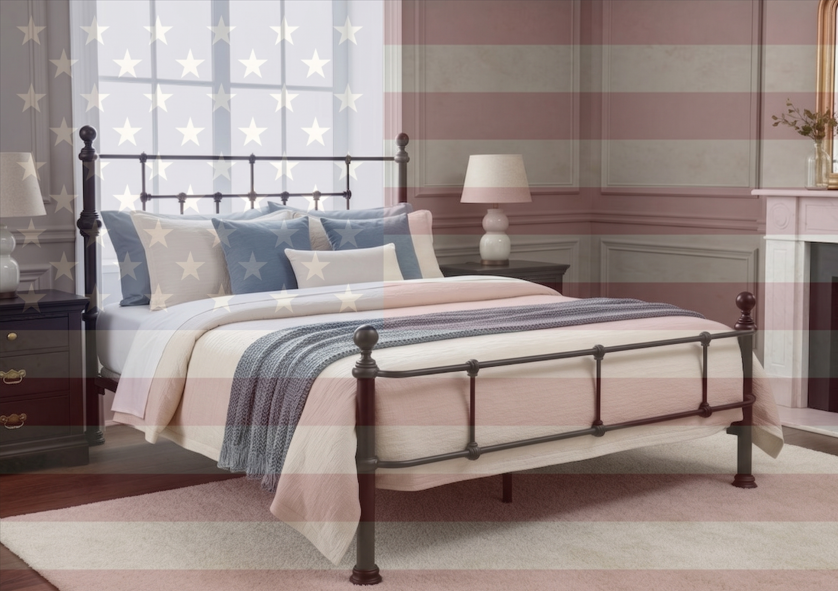
When you search for iron beds made in USA, you are not just looking for a country-of-origin label. You are looking for a set of real advantages that domestic manufacturing delivers and that imports rarely match: heavier materials, hand-applied finishes, custom options, direct warranty support, and a workshop you can actually reach by phone. The question is not whether American made iron beds cost more. The question is what you get for the difference, and whether it is worth it.
We build every iron bed we sell in Los Angeles by our manufacturing partners. We have been doing it for more than 25 years. This guide walks through what "American made" actually means in the iron bed category, the construction and service advantages you can expect, and what to verify before you buy.
What "American made" actually means for iron beds
The phrase "made in USA" has been stretched to the breaking point across the furniture industry. For iron beds specifically, it can mean anything from a fully domestic operation where materials are sourced, welded, cast, and finished in the same workshop, to a foreign-built frame that was merely assembled in a domestic warehouse from imported components.
A genuinely American made iron bed meets four tests.
Materials sourced domestically. The steel tubing, iron rod, and raw casting material come from domestic suppliers. This is not just a point of pride, it is a quality control question. Domestic steel is easier to verify against published specifications, and for structural products like bed frames, that traceability matters.
Built and welded in a domestic workshop. The cutting, bending, welding, and grinding all happen in the same facility, by workers employed by the company selling the bed. This is where the bulk of construction labor lives, and where most outsourcing happens when a company wants to cut costs while still claiming domestic manufacturing.
Castings poured and fit domestically. The decorative and structural castings are hand-poured in a domestic foundry, inspected, and integrated into the frame at the same workshop. Imported castings are usually the first giveaway that a bed is not fully American made, because casting work is one of the most labor-intensive and easiest to offshore.
Finished by American artisans. The multi-step hand-applied finish is built up by finishers working at the same workshop. This is the single most visible indicator of domestic craft labor in an iron bed, and a quality maker will tell you exactly where and how finishing happens. Read more about our process on our about page.
A bed that misses any of these four tests is not fully American made. It is partially American, which is a different thing, and worth paying a different price for.
Quality advantages of domestic iron bed manufacturing
American manufacturing is not just a labor-origin story. It produces measurably different product because the economics of domestic production push toward heavier materials and more careful construction rather than the opposite.
Heavier materials throughout the frame. An overseas manufacturer has to absorb the cost of container shipping, which rewards beds that are lighter rather than heavier. A domestic manufacturer does not. This is why American made iron beds tend to use heavy-gauge, thick-walled steel tubing where imports use thin-wall steel or aluminum. The cost structure rewards weight instead of punishing it.
Direct quality control at every stage. When the welding, casting, and finishing all happen under one roof, defects are caught at the bench, not in a shipping container three weeks later. In our experience, this is the practical reason domestic iron beds tend to have lower defect rates than imports.
Hand-applied finishes, not automated spray lines. Large overseas factories run automated spray finish lines that lay down a single coat of paint. Domestic iron bed workshops run multi-step hand-applied finishes that include primer, base, patina, and sealer layers applied in sequence by a finisher, not a robot. For the full breakdown of what separates these two approaches, see our guide to hand-forged vs machine-made iron beds.
Workshops flexible enough to run one bed at a time. An overseas factory is built for 200-unit production runs in standard sizes and standard finishes. A domestic workshop can build one bed, in a non-standard size, in a specific finish combination, to a specific rail height, without changing the production process. This is the foundation of custom work.
Hand-applied finishes are unique to each piece. Color and patina will vary naturally. Images shown are for reference only.
For the full set of construction markers that separate quality iron beds from cheap ones, see our guide to what to look for in a quality iron bed.
The practical benefits buyers notice
The manufacturing advantages show up in practical, day-to-day ways once the bed arrives.
Faster lead times than overseas manufacturers. Our production window is 6 to 8 weeks, start to finish. An overseas iron bed typically runs 12 to 20 weeks because the container shipping and customs clearance are built into every order. If your timeline matters, domestic is not just better, it is a different category.
No international shipping damage. An iron bed that sits in a container for four to six weeks, gets loaded and unloaded multiple times, and passes through two or three freight networks is a bed that arrives with scratched finishes and bent components at a non-trivial rate. A domestic bed that ships directly from the workshop to your door via one freight network arrives in the condition it left.
Warranty backed by a company you can call. Every American made iron bed carries a domestic warranty that you can exercise by phone, with a human, in your time zone. Imported beds carry warranties that are often honored through a third-party retailer rather than the manufacturer, which means warranty claims go through an intermediary who did not build the bed and cannot replace components directly.
Custom sizing, finish, and height adjustments. Our workshop can modify rail height, build non-standard sizes, combine finish techniques, or accommodate specific design requests because the production process is flexible enough to handle single-bed runs. Overseas factories cannot.
Direct communication with the people who build your bed. When you call us, the person on the phone knows how the bed is built, what options exist, and what the lead time looks like because they work down the hall from the workshop. This is not a call center. It is the same company.
Supporting American craftsmanship
The iron bed industry in America has deep roots. Iron beds first appeared in meaningful volume in the 1840s and became the standard American bedroom furniture in the second half of the 19th century, as domestic foundries and metalworkers scaled up production for hotels, hospitals, and homes. By the 1890s, iron beds were in nearly every American bedroom, and they were nearly all made here.
The industry contracted dramatically in the mid-20th century as upholstered beds and wood bedroom sets took over the mass market, and then contracted again in the 1990s and 2000s as overseas manufacturing took over the remaining iron bed category. Today, the number of domestic workshops still doing this work at scale is small. Each one represents decades of accumulated technique, tooling, and supply relationships that cannot be rebuilt quickly once they are gone.
Buying from a domestic iron bed maker is not just a consumer transaction. It keeps a narrow, specialized craft tradition functioning in the United States. For the longer story of how iron beds have been built across three centuries, see our guide to the history and construction of iron beds.
For a direct comparison between AIB and other iron bed sellers on construction, service, and manufacturing, see our iron bed competitor comparison.
Frequently asked questions
Are American made iron beds more expensive? Yes. American made iron beds typically cost two to three times more than comparable imports at the entry price point, and the gap narrows at the high end. The price reflects real differences: heavier materials, hand-applied finishes, custom availability, and lifetime warranties. Spread across decades of ownership, the cost per year of use often comes out lower than the cheaper import that fails in two to five years.
How do I verify an iron bed is truly American made? Ask the manufacturer four specific questions: where is the workshop located, where is the steel sourced, are the castings poured domestically, and is the finish applied in-house. A legitimate American maker will answer all four with specifics, including the city and state of the workshop. Vague answers, redirection, or "assembled in USA" phrasing without details usually signals imported components with domestic assembly.
Which iron bed brands are made in the USA? Rather than chasing brand names, evaluate any iron bed seller against the four-test standard above: domestic materials, domestic welding, domestic castings, and domestic finishing. A handful of specialty workshops meet all four criteria. The best way to confirm is to call the company and ask them to walk you through their manufacturing process. A real domestic manufacturer will answer without hesitation.
Are there American made iron beds for under $1,000? Rarely, for a complete queen or king bed. Domestic labor, heavier materials, and hand-applied finishes produce a cost floor that typically starts in the $1,000 to $1,500 range for a simple American made iron bed and climbs with design complexity, casting work, and finish. If you find a complete American made queen under $800, verify the manufacturing tests above carefully, because something in the cost structure has been cut.
How long have iron beds been made in America? Since the mid-19th century. American iron bed production began in meaningful volume in the 1840s, grew rapidly through the 1870s and 1880s as casting and welding techniques matured, and reached a peak around the turn of the 20th century when most American bedrooms contained an iron bed. The construction methods used by the best American iron bed makers today are direct descendants of the techniques developed in that period.
Frequently Asked Questions
Ready to Find Your Perfect Iron Bed?
Browse our collection of handcrafted iron beds, each built to last a lifetime in Los Angeles by our manufacturing partners.
American Classics collectionAmerican Iron Beds
Handcrafting Iron Beds in Los Angeles Since 1999
Founded in 1999, our iron beds are handcrafted in Los Angeles by our manufacturing partners using construction methods proven since the late 1800s — thick-walled steel tubing, solid iron rod, and hand-poured metal castings. Every bed comes with a lifetime structural warranty.
Continue Reading
 Iron Beds & Frames
Iron Beds: The Complete Buyer's Guide for 2026
Everything you need to know before buying an iron bed frame: types, styles, sizes, construction quality, and care. A comprehensive buyer's guide from a manufacturer with 27+ years of experience.
 Iron Beds & Frames
What to Look for in a Quality Iron Bed
The 7 markers of a quality, heirloom iron bed: thick-walled tubing, hand-poured castings, finish, weight, and what to ask before buying.
 Iron Beds & Frames
Hand-Forged vs Machine-Made: Why Iron Bed Craftsmanship Matters
Learn the real differences between handcrafted and mass-produced iron beds. Compare construction, materials, finishes, and durability before you buy.
 Iron Beds & Frames
American Iron Beds vs the Competition: What Sets Handcrafted Apart
Compare iron bed companies on materials, construction, finishes, warranty, and customization. See why handcrafted American-made iron beds outperform the rest.